Highlights from MIPIM’s Road to Zero Stage on how real estate leaders are delivering decarbonisation across active, income-generating buildings
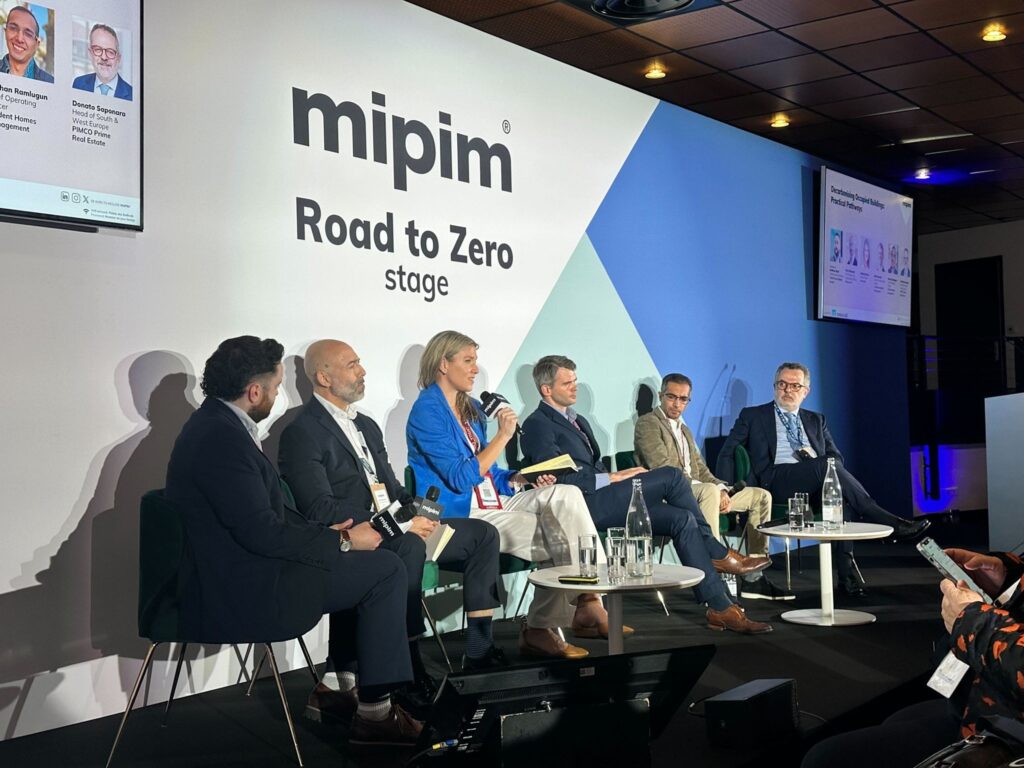
Last month, we joined industry leaders at MIPIM 2026 in Cannes to connect on key trends in the market today.
Among the many insightful conversations with customers, partners, and peers, we were honoured to be included in a panel discussion that explored a defining challenge for the industry today.
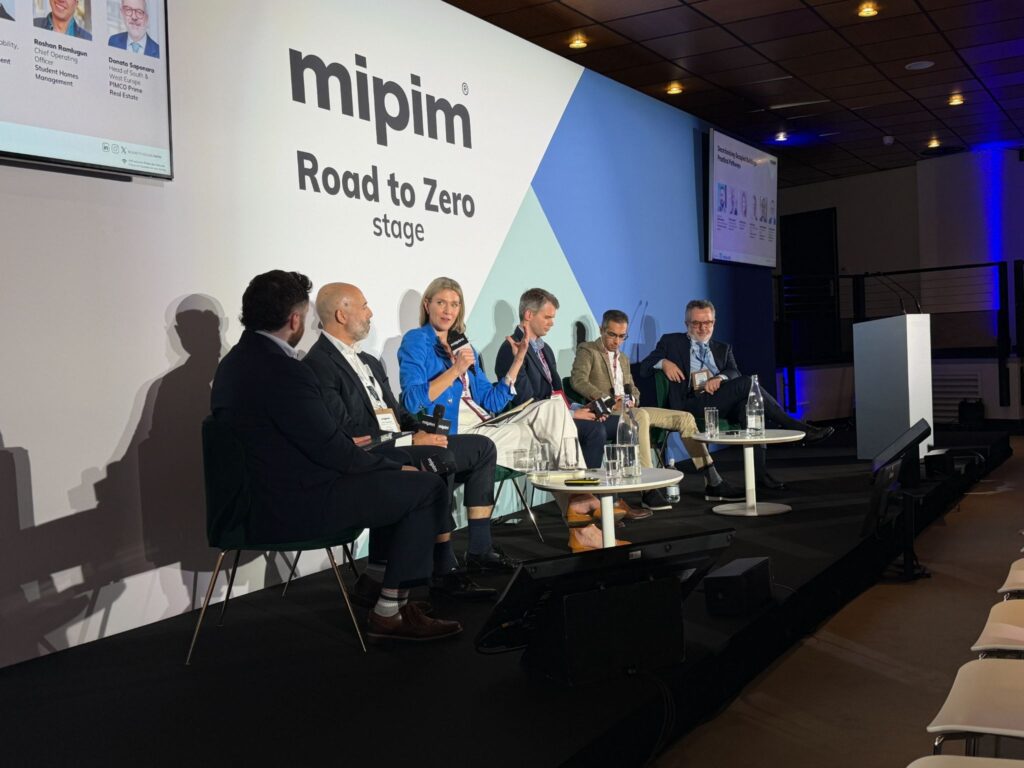
In “Decarbonising Occupied Buildings: Practical Pathways,” Aislinn McCarry, Head of EMEA at Measurabl, joined industry leaders to explore how decarbonisation is being delivered in practice across active, income-generating assets.
The session opened with remarks from Matt Black, Climate Action Manager at the World Green Building Council, who framed the scale—and urgency—of the challenge. As policies tighten and performance standards evolve, decarbonisation is becoming critical to managing regulatory and financial risk, improving resilience, avoiding stranded assets, and securing long-term asset value.
Overall, the prevailing theme in the discussion was that decarbonisation in occupied buildings is fundamentally a strategic challenge—one where data-driven execution ensures that every deployment of capital delivers measurable value and the expected results.
Here are the key takeaways.
1. Data-driven decision making creates the most impact when translated into stakeholder value
Capital deployment now depends on data to justify investment and prove value. But data alone is not enough—its impact depends on how it is translated into outcomes that matter for the relevant stakeholder(s).
Leading organisations are centralising sustainability data management, ingestion and analysis to evaluate multi-faceted climate strategies across physical climate risk, transition pathways such as CRREM, and asset-level performance; moreover, this data is increasingly being used to inform investment decisions. For this reason, it is critical that insights are communicated in the language of the respective stakeholder, namely: financial performance for investors and asset managers, and comfort and cost for occupiers.
This requires translating technical metrics into clear, transparent outcomes that demonstrate return on investment and real-world impact. At both the portfolio and asset level, the ability to connect performance data to business value is what builds momentum, supports decision-making, and enables organizations to scale decarbonisation efforts with confidence.
“It’s about using data to speak the language of your audience. As fiduciaries, asset managers must protect asset values and make financially sound decisions—so the conversation is in dollars and cents, pounds and pence.
At the end of the day, it’s the ‘so what.’ What was my return on investment? Did this add value? And can I demonstrate that, and build momentum from it?”
— Aislinn McCarry
2. Performance and ROI must be validated with data in real time
As decarbonisation strategies move from planning to implementation, the focus shifts to whether buildings are actually operating as intended. With increased deployment of sensors, control systems andIoT technologies, organisations now have access to more data than ever. he challenge remains how to this data into actionable insight.
“It’s very easy to be data rich but information poor. The value comes from using that data to understand whether buildings are actually performing as intended—and whether the return on investment is being realised.”
— Aislinn McCarry
Leading teams are using real-time data to monitor operating conditions, validate that design assumptions are being met, and ensure that capital investments are delivering expected outcomes. This is critical not only for tracking ROI and managing costs, but also for maintaining tenant comfort and satisfaction.
In practice, success depends on closing the gap between design and operation—using data to confirm that performance improvements are real, measurable, and sustained. Advances in AI are accelerating this shift—from automating data collection through utility bill extraction and smart meter integration, to enabling faster, more informed decision-making at scale.
3. Execution requires accountability and integration into core operations
Leading organisations are embedding decarbonisation into day-to-day operations and performance management.
This includes requiring year-over-year energy tracking, ensuring timely data capture, and creating accountability for identifying and implementing performance improvements. KPIs are increasingly applied at multiple levels—from portfolio-wide targets linked to financing structures to asset-level metrics that validate whether specific interventions are delivering results.
When combined with strong asset and property management, sustainability initiatives create a multiplier effect on value. Without data-driven monitoring, even well-funded initiatives risk underdelivering on their intended outcomes.
4. Capital is flowing to measurable performance
Demand is rapidly increasing from lenders and the broader market for high-quality, asset-level sustainability performance data to support underwriting and portfolio analysis. While sustainability-linked financing has historically focused on energy performance, the market is shifting toward decarbonisation-aligned metrics, including pathways such as CRREM.
At the same time, transparency and benchmarking are creating a form of “healthy competition,” where assets are increasingly evaluated relative to peers. This is reinforcing a broader shift: access to capital—and market competitiveness—is increasingly tied to the ability to demonstrate measured performance improvements and savings.
Watch the full video of the panel here.
During MIPIM, Measurabl was also honored with the Compliancy Award at the Global ESG Awards, presented by EUBIN. Learn more about the recognition here.